
WiFi survey equipment rental vs managed survey service
WiFi survey equipment rental vs managed survey service
Decide whether to rent WiFi survey equipment, hire a managed survey service, or combine rental with PacketScout planning/report support.
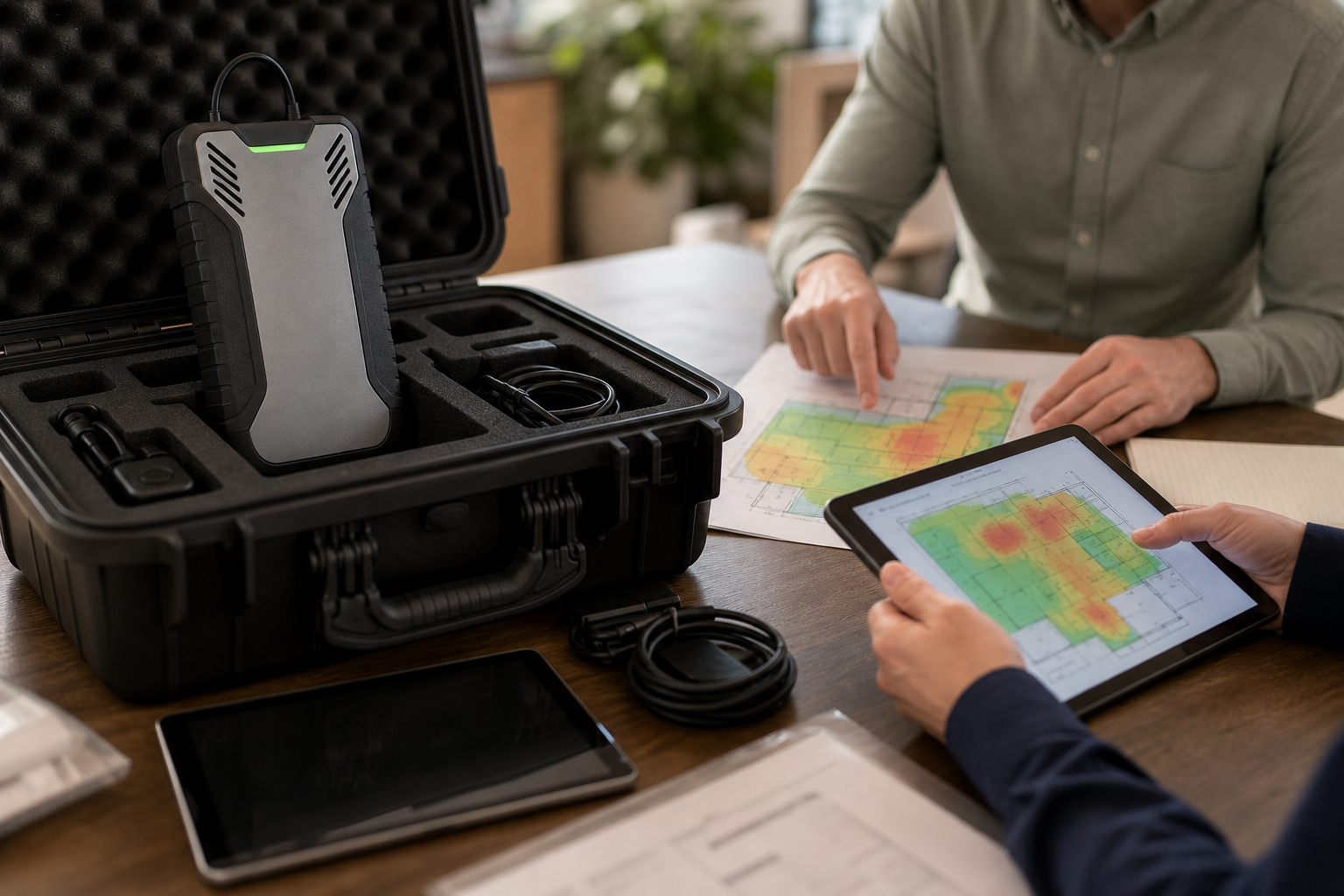
WiFi survey equipment rental and managed survey service solve different problems. Rental gives a capable team access to the measurement hardware. Service gives a team planning, field execution, interpretation, and recommendations. Many projects need both.
The wrong choice can waste money. Renting equipment without a plan can produce weak data. Hiring a full service team for a simple validation walk may be more than the project needs. The best path depends on risk, building complexity, staff experience, map quality, and what decision the survey must support.
Quick decision matrix
| Situation | Best fit |
|---|---|
| Your IT team can walk the site and understands survey workflow | WiFi survey equipment rental |
| You need PacketScout to plan, walk, analyze, and recommend | WiFi site survey services |
| You can collect data but need interpretation | Rental plus PacketScout report review/support |
| The site is a warehouse, manufacturing floor, or scanner heavy environment | Warehouse WiFi survey and design |
| The project is a new build or remodel | Wireless network design services |
| You only need heatmap/report validation after changes | WiFi heatmap services |
What rental does well
Rental is useful when the team already knows the site and can collect clean data. It can be a good fit for:
- IT teams with survey experience
- small validation walks
- follow up checks after a known change
- teams that already have floor plans and clear scope
- organizations that need hardware for a short window
- projects where PacketScout will review results after collection
Rental works best when someone owns the field workflow: maps, scale, scope, paths, notes, and report review.
Where rental can go wrong
A measurement device cannot fix poor preparation. Common rental mistakes include:
- unscaled or distorted floor plans
- walking only hallways or easy areas
- skipping locked rooms, aisles, docks, or complaint zones
- not documenting AP locations and obstructions
- collecting data without knowing the objective
- treating a signal heatmap as a complete design
- missing SNR, noise, channel, client, or application context
If those risks are present, a hybrid or service path may be better.
What managed survey service adds
A survey service should add judgment and accountability:
- project scoping
- survey type selection
- floor plan preparation review
- onsite data collection
- field notes/photos
- RF analysis
- AP placement and channel/power recommendations
- report interpretation for IT and facilities
- post change validation plan
Service is strongest when the project is complex, the building is hard to access, the network is business critical, or the final answer needs to guide spending.
When a hybrid path fits
A hybrid path is useful when the customer can walk the site but wants PacketScout involved in planning or interpretation. Example workflow:
- PacketScout helps define the survey objective and map requirements.
- Customer rents the equipment and walks the site.
- Customer sends project files, notes, and photos.
- PacketScout reviews the data and identifies gaps or next steps.
- PacketScout helps decide whether AP moves, additional APs, channel/power changes, or a professional follow up survey are needed.
This can reduce onsite cost while still preventing bad conclusions from weak interpretation.
Questions to answer before choosing
- Do we have accurate floor plans?
- Can our team scale maps and walk accurately?
- Do we know which areas and devices matter?
- Is this a warehouse, clinic, school, office, or outdoor transition space?
- Are we troubleshooting, validating, designing, or documenting?
- Do we need a recommendation or only raw measurement data?
- Who will review SNR, noise, channel behavior, AP placement, and client issues?
- What happens if the first survey shows gaps or questionable data?
If the answer to several questions is unclear, start with a planning call or service quote rather than equipment alone.
PacketScout next steps
- Use the Ekahau Sidekick Field Guide before a rental survey.
- Use the WiFi Site Survey Checklist to prepare maps, scope, and access.
- Use WiFi heatmap services when you need report generation or validation.
- Use WiFi site survey services when you need PacketScout to handle the field work.
Cost and risk comparison
The cheapest option on paper is not always the cheapest project. The real cost is the cost of getting to a usable decision.
| Risk | Rental only impact | Service or hybrid impact |
|---|---|---|
| Bad maps | Customer may collect data that is hard to interpret | Maps can be reviewed before the site visit |
| Unclear scope | Survey may miss the areas that matter | Scope can be translated into a walking plan |
| Warehouse complexity | Scanner/dock/aisle issues may be under sampled | Field workflow can target operational paths |
| Weak notes | Report may show colors without explaining conditions | Photos/notes can be planned and captured consistently |
| No RF interpretation | Customer may over trust signal heatmaps | SNR/noise/channel/AP placement can be reviewed |
| Need for recommendations | Rental does not automatically produce an action plan | Service turns findings into next steps |
A rental only project can be excellent when the team is prepared. A service project can be overkill when the team only needs a short validation walk. The decision should be based on project risk, not pride.
Examples
Small office validation
A small office with a good floor plan, known AP locations, and one or two complaint areas may be a good rental or hybrid candidate. Your team can walk the site, then ask PacketScout to review the heatmap and check whether the findings support a small channel, power, or AP placement change.
Warehouse scanner complaints
A warehouse with scanner drops, high racks, dock doors, moving inventory, and forklift mounted devices is higher risk. Rental can still work if your team understands the walking path and notes required, but a service or hybrid path is usually safer because the final answer must account for client devices, aisle coverage, channel reuse, and operations.
New build or remodel
A new build often starts with predictive design and then validation after installation. Rental equipment alone does not create the predictive design. A hybrid path can make sense later when the installed network needs validation.
What to send PacketScout for a hybrid review
If you collect the data and want PacketScout to review it, send:
- project file/export from the survey tool
- floor plans used for the survey
- notes/photos from problem areas
- AP list or controller export if available
- known SSIDs/bands in scope
- client device list, especially scanners/phones/voice devices
- the business symptom: drops, slow scans, video issues, roaming, guest complaints
- any areas skipped or not accessible
Clear inputs make report review faster and reduce guesswork.
FAQ
When does WiFi survey equipment rental make sense?
Rental makes sense when your team can prepare maps, walk accurately, collect clean notes, and interpret the data or send it to someone who can.
When should we hire a managed survey service?
Hire a service when the project is high risk, time sensitive, multi floor, warehouse heavy, or when you need recommendations rather than only raw data.
Can we rent equipment and still get help?
Yes. A hybrid path can work well: your team collects data with rented equipment, then PacketScout helps plan the survey, review the report, or turn findings into an action plan.
Rental should stay a first class option
A rental project is not a second tier choice. If your team can walk the site, follow the map, take notes, and export the project cleanly, renting survey equipment can be the right answer. It keeps cost down and gives your team a closer look at the building.
Use managed survey help when the project has risk that your team does not want to own: warehouse scanners, high density rooms, 6 GHz rollout, AP on a stick testing, executive deadlines, or a report that has to justify cabling and AP moves. Use rental when you mainly need the hardware and a clear plan.
Use rental when your team mainly needs hardware and a clear plan. Use service when the project needs field execution, design, remediation, or accountability.
Want PacketScout to review the site?
Send the floor plan, square footage, AP model, critical devices, and the problem you are trying to solve.